Handling mixed-species stands in a biomass regression model
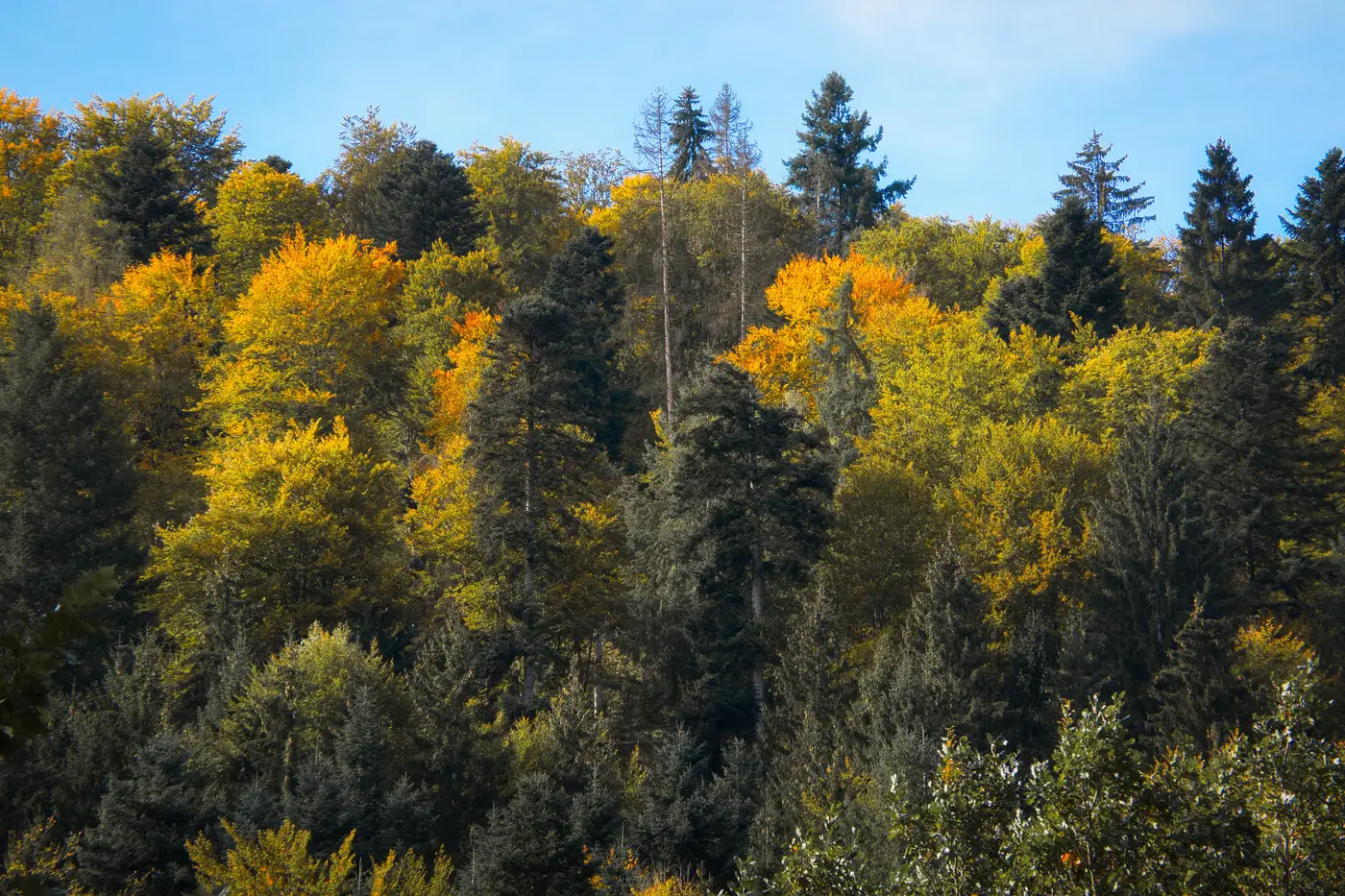
Mixed-species stands are the normal case on most landscapes a carbon registry asks you to report against. A pure conifer plantation regresses cleanly: one wood density value, one crown allometry curve, one set of spectral signatures to calibrate against. A secondary hardwood forest with scattered conifer inclusions, a riparian buffer mixing cottonwood and willow, a post-fire stand regenerating with three or four species at different rates, none of that behaves like a single population. Fit one pooled regression across all of it and the model ends up biased low in some strata and high in others, even if the overall scatter plot looks acceptable.
Why pooled models fail on mixed stands
Different species convert canopy structure to biomass differently. A dense, round-crowned hardwood and a narrow-crowned conifer of the same height can carry very different stem biomass per unit of crown area, because wood density, height-to-diameter ratios, and branch architecture all feed into the underlying allometric equations as species-specific terms. A regression trained on canopy height and a spectral index, without accounting for species composition, is implicitly assuming the plot network used to build it had the same species mix as every pixel it's now predicting. In a mixed stand that assumption breaks down pixel by pixel.
The symptom usually shows up as residual error that correlates with something other than canopy height, most often forest type, age class, or time-since-disturbance. Color your residuals by species group and a clean-looking model often turns out to have a pattern hiding in it.
Stratify by species group before you regress
The standard fix is to stratify first and regress second. Split the landscape into species groups or forest types using whatever classification you already have, a national land cover product, a prior inventory stratification, a spectral unmixing step, then fit a separate regression, or at least a separate set of coefficients, within each group. This keeps the wood-density and allometric assumptions reasonably uniform inside each stratum instead of averaging them across populations that don't belong together.
A few things determine whether that stratification holds up under review:
- Each stratum needs enough field plots to support its own fit. A species group with four calibration plots doesn't earn its own equation; it gets folded into the nearest comparable group, with the reasoning written down.
- Stratum boundaries should be stable cycle to cycle, or at least versioned, so a reviewer can see why a parcel moved from one group to another between reporting years.
- Transition zones, where two forest types interleave at a fine scale, are where stratified models still show seams. A hard cutoff between strata produces a visible edge in the biomass layer that doesn't match what's standing on the ground. Some teams blend coefficients across a buffer distance at the boundary instead of switching abruptly.
Mixed composition within a single stratum
Even inside a well-chosen stratum, individual plots or pixels often carry two or three species in the same canopy. For those, a mixture term, a basal-area-weighted composite wood density, or a secondary spectral covariate tracking species proportion tends to outperform forcing the pixel into one label. It's more setup than a single pooled curve, and it depends on field data that records species composition per plot, not a dominant-species tag. That data requirement is usually the real bottleneck, not the regression method.
Keeping the stratification current
Species composition shifts after fire, harvest, or windthrow, and a stratification built from a five-year-old land cover layer drifts out of sync with what's actually standing. None of this is a one-time calibration. A biomass layer that regresses canopy structure and spectral response across your landscape every cycle, the way our annual biomass mapping offer is built to run, at least gives you a consistent basis for catching that drift instead of carrying forward a stratification nobody has revisited since the last field campaign.
If your landscape runs to more than one dominant species group, settle the stratification before the regression step produces numbers that look wrong for reasons nobody can trace. We're glad to talk through where a wide-swath annual layer fits into that workflow.